

‘Passing’ the get up test or missing the point?
A score out of ten. A link to longevity. But is “passing” the test the goal, or is something else more important?

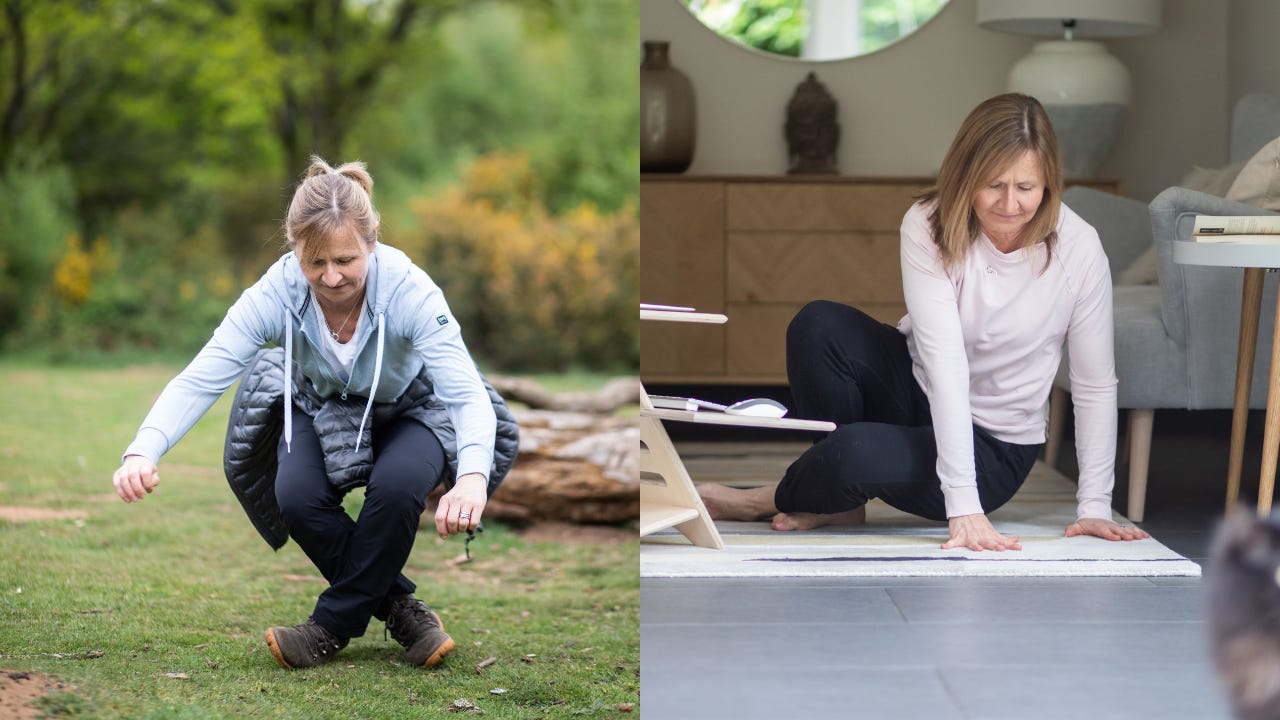
I was prompted to write this blog because someone asked me for some technique tips to help them achieve the cross-sit get up. This is where you get up to standing straight from sitting cross-legged. I couldn’t do this before my natural movement certification training, and it took me a few months of researching how to build up to it, combined with working on my mobility and strength.
Most people want to get up this way because they’ve heard about the longevity test that looks at your ability to get up off the ground without using your hands or knees. The highest score is given for doing this quickly, and that score is linked with better health outcomes over the following years in the original study.
I get that giving ourselves the badge of a 10 out of 10 may feel reassuring, like proof that we’ve “passed”. But it’s so important to think about why this study was constructed, and what getting up off the ground actually represents.
When tests don’t give us the whole story - understanding what’s really being measured
The ability to get up off the floor without using your hands or knees is not ‘causal’ for long-term health outcomes, meaning it’s not the case that “doing this movement makes you live longer”.
Instead, it’s a predictor or marker. The way of getting up doesn’t cause longer life, it reflects your underlying overall physical health and therefore can be used to predict that “People who can do this tend to live longer and have better health outcomes.”
The original study (published in the European Journal of Preventive Cardiology, 2012), which I cite in my book, found that adults who scored lower on the sit-to-rise test had a higher mortality risk over approximately six years, and most importantly, each additional point in score correlated with lower risk.
The reason researchers like the test, despite it not being causal, is because it’s quick to test, equipment-free, holistic, and ends up being surprisingly predictive.
What sits behind the score?
The test compresses multiple health capacities into one movement:
* Mobility (joint health + injury risk)
* Strength (especially lower body strength)
* Balance (a fall-risk predictor)
* Flexibility (linked to functional independence)
* Body composition (increased bodyweight reduces ease)
So someone who can rise easily usually has good neuromuscular coordination, decent muscle mass, a healthy weight, and functional joints. And it’s ALL these factors and more combined, that are associated with longevity.
The test is neutral - our response isn’t
The issue I have with many of these tests is how the person reading about them responds to them.
If, for example, you’re feeling fairly capable, you get up and down to the ground regularly, you’d likely achieve a higher score to start with, and you already move in ways that mean you feel mobile, strong and capable, then you might read about this and think, “I wonder if I can do that.” You may know you’ll need a bit of training to get there, but it’s coming from a stable mindset base.
If however, you are not as capable as you’d like, and you read that this test is linked with likely health outcomes, and then when you go to try it you struggle, need to use your knees and hands, and end up feeling worse about yourself than before you started… that’s a different story. If the result isn’t motivating but instead feels shaming, then I would urge you not to keep pushing at it in that moment. Have self-compassion, and have a think about whether you want to act on this information or not.
Action is always better than inaction
If it makes you feel like this is something you want to work towards, then great. But again, have self-compassion and know that although it’s never too late to progress, it may take time and consistency, and you may need to build up slowly and with care.
Why trying counts more than perfect, in my humble opinion
Because you’re trying at all, please, please give yourself a pat on the back every time you try. If you keep trying, you will notice a difference over time.
Those in my signature course spend the first three weeks learning to bring floor-time into their lives, and they always surprise themselves with how quickly change occurs, how they are often stronger than they realise, and how much they enjoy this new element to their lives.
For these reasons, I feel that rather than focussing solely on one type of get up, and perhaps seeing it as the panacea, it’s far better to think about how to bring more ground time into your life. By sitting there you’re improving your mobility. By moving there you’re building strength and coordination too. And by getting up and down in a whole range of different ways, you’re getting all of these benefits and more, like improved balance, stability and confidence.
After all, if you only ever used a get up that didn’t use your arms or knees, you’d actually be giving your body fewer inputs. You’d be missing out on the brilliant weight-bearing movements that come with pushing through the arms, which strengthen wrists, shoulders and core. And it’s likely those are the get ups you’d want available to you if you fell and needed to get yourself up, or to help someone else.
Beyond “passing” the test - move well for life
So rather than focus on “passing the test”, let’s think more about all the ways to move, and how to incorporate those types of movements naturally into our daily lives, so that we move well for life. Because those types of movements are what build the resilience and capability that can keep us more independent in later years, so we can keep doing the things we love, with those we love.
If you’d like to be supported to start reclaiming the ground, and would relish the accountability and support from a group learning experience, with personal input from me in a group community and weekly workshops - join the waiting list for the next ‘Reclaim Everyday Ease’ signature course that starts at the end of April.
You can also get going yourself now with the self-paced version for £297 and if you feel some extra accountability will help solidify your learning, you can upgrade to join the next live cohort nearer the time.